Best AI Glasses Try-On & Frame Finder Tools (2026)
AI glasses tools do two different jobs: virtual try-on and frame-finding. An honest, independent 2026 guide to the best of both — from someone with no frames to sell.

You've virtually "tried on" thirty pairs of glasses. They all look… fine. You still have no idea which ones actually suit you.
That's not your fault. It's the tools.
Almost every "AI glasses" tool is really doing one of two completely different jobs — and most people confuse them. One shows you what a specific frame looks like on your face. The other tells you which frame shapes suit you in the first place. You need both answers, and no single tool sells you both honestly, because nearly every one is run by a company that wants to sell you glasses.
This is the independent version — no frames to sell. Here's how the two kinds of tools work, which are worth using, the fit details every seller skips, and the honest limits of "trying on" a pair of glasses through a screen.
Two Kinds of "AI Glasses" Tools (Don't Confuse Them)
Before any tool, get this distinction straight — it's the whole game.
| AR Virtual Try-On | AI Frame Finder | |
|---|---|---|
| Answers | "What do these frames look like on me?" | "Which frame shapes suit my face?" |
| You pick the frame? | Yes — you choose, it renders | No — it tells you which to choose |
| How | Live camera + 3D face-mapping overlays a frame | Detects your face shape, maps it to flattering geometry |
| Who runs it | Mostly eyewear retailers | Retailers and standalone AI tools |
| Cost | Free tool; you pay for glasses | Usually free; may not sell glasses at all |
Most retailer tools now bolt both together — a try-on mirror plus a "face analysis" advisor. The rarer, more genuinely useful product is the pure frame finder: advice first, no catalog to push. The smartest workflow uses both — decide which shapes suit you, then see those shapes on your face.
First, the Part Every Tool Skips: Fit
Here's what sellers bury: the right shape in the wrong size is still the wrong pair of glasses. Fit is the constraint; shape is the style layer on top. Every frame carries measurements that matter more than its silhouette:
- Frame width vs face width — the frame should sit slightly wider than your face, with no more than a finger's width between the temple and your cheek, and your eyes centered in the lenses.
- Bridge width (the nose gap, ~14–24 mm) — the single biggest reason frames slip or pinch.
- Temple length (the arms, commonly 135–150 mm) — must reach behind the ear without pressing.
- Lens height — needs to be tall enough (≥30 mm) if you wear progressive or bifocal lenses.
A "correct-shape" frame that's too wide slides down your nose; too narrow and it pinches and leaves marks. Any tool that talks only about face shape and never about width, bridge, or temple length is selling you style, not fit. Start with the size numbers.
Which Glasses Suit Your Face Shape
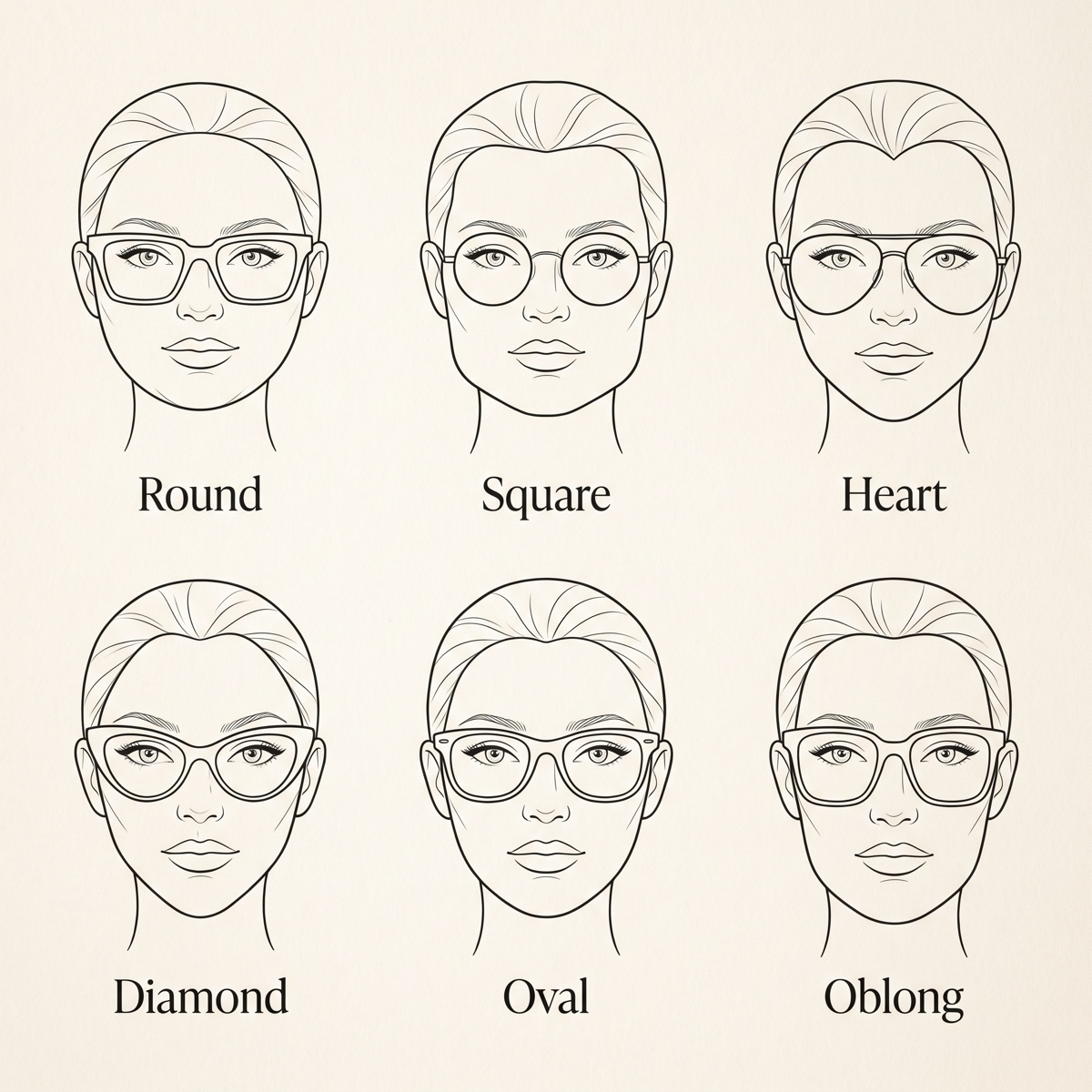 Best eyeglass frame shapes for round, square, heart, diamond, oval and oblong face shapes
Once fit is handled, shape is where the "AI" recommendation actually earns its keep — and opticians are remarkably consistent about the rule: choose frames that contrast your face's dominant geometry, and match the frame width to your widest point. Angular faces are softened by curves; soft faces are defined by angles.
| Face shape | Flattering frames | Why |
|---|---|---|
| Round | Angular — square, rectangular, geometric | Adds definition and length |
| Square | Round, oval, aviator, semi-rimless | Softens a strong jaw |
| Heart | Bottom-heavy, rounded, aviator | Balances a wide brow and narrow chin |
| Diamond | Cat-eye, oval, browline, rimless | Widens the forehead, softens cheekbones |
| Oval | Almost anything | Already balanced — match your widest point |
| Oblong | Tall, deep frames; decorative temples | Shortens a long face, adds width |
An "AI frame finder" is simply automating this optician logic — it classifies your face shape, then applies these rules. Not sure of your shape? Our complete face shape guide walks you through measuring it, and our roundup of AI face shape apps compares the tools that detect it.
One honest caveat every optician repeats: these are guidelines, not laws. Personal style, prescription, hair, and lifestyle all legitimately override them — and most people are a blend of two shapes anyway.
How AR Virtual Try-On Works — and What It Can't Do
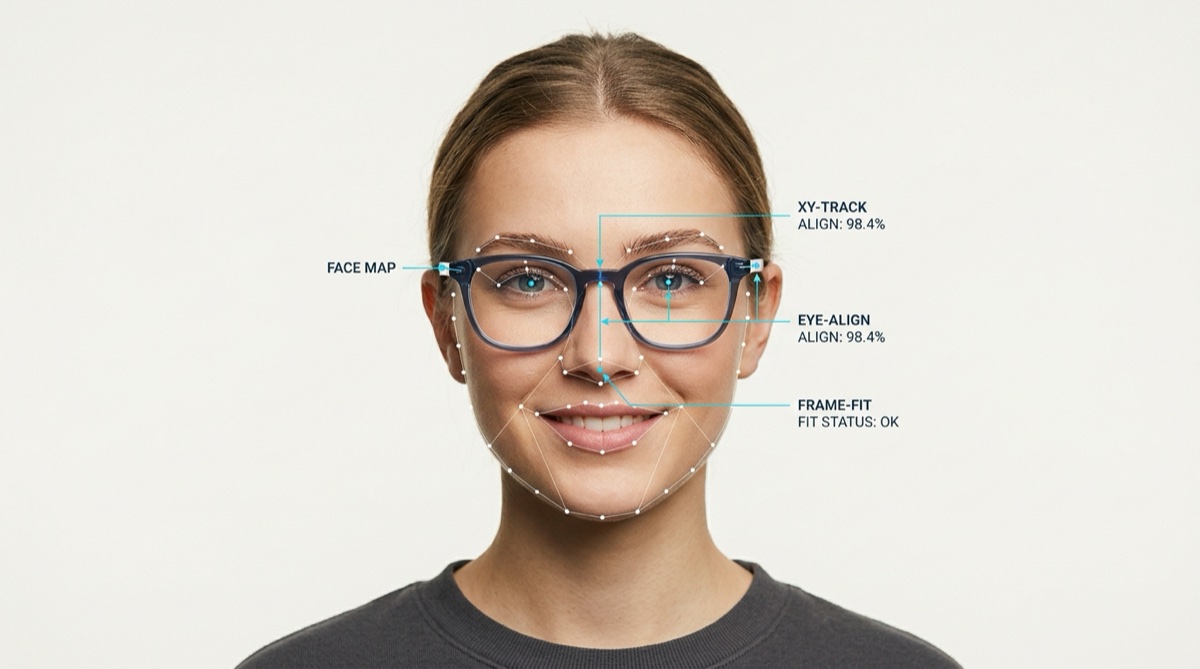 How AR virtual try-on maps a face to overlay eyeglasses in 3D
When you tap "try on," the tool maps a mesh of points across your face, then overlays a 3D model of the frame — not a flat sticker — anchoring it to your nose bridge and eyes and re-solving the position each time you turn your head. On an iPhone with a TrueDepth camera, it reads actual facial depth, so the fit renders more accurately than a flat selfie on a laptop.
Some tools also estimate your pupillary distance by having you hold a standard credit card (a fixed 85.6 mm wide) against your face for scale.
That's genuinely useful for one thing: visualizing style, proportion, and rough color. Here's what it honestly cannot do:
- You can't feel it. No tool conveys weight, nose-pad pressure, or whether the frames pinch or slip — the things that actually decide comfort.
- Color isn't true. Your camera and screen shift the frame's real color and finish.
- Fit is estimated. Card-based PD is fine for choosing a frame size, but it's not a substitute for a professionally measured PD for centring prescription lenses.
When a retailer says its try-on "measures your PD" and is "highly accurate," read that as style accuracy. Bridge and temple fit usually still need a real-world adjustment.
How We Chose These Tools
For the transparency the rest of this category avoids: MaxAura makes one of the tools below — a frame finder, not a try-on mirror or a store. So we've kept it in its lane and been clear about what it doesn't do, and we've judged every tool on whether it's a genuine try-on, a genuine recommender, or both — plus price transparency and privacy.
The Best AI Glasses Tools of 2026
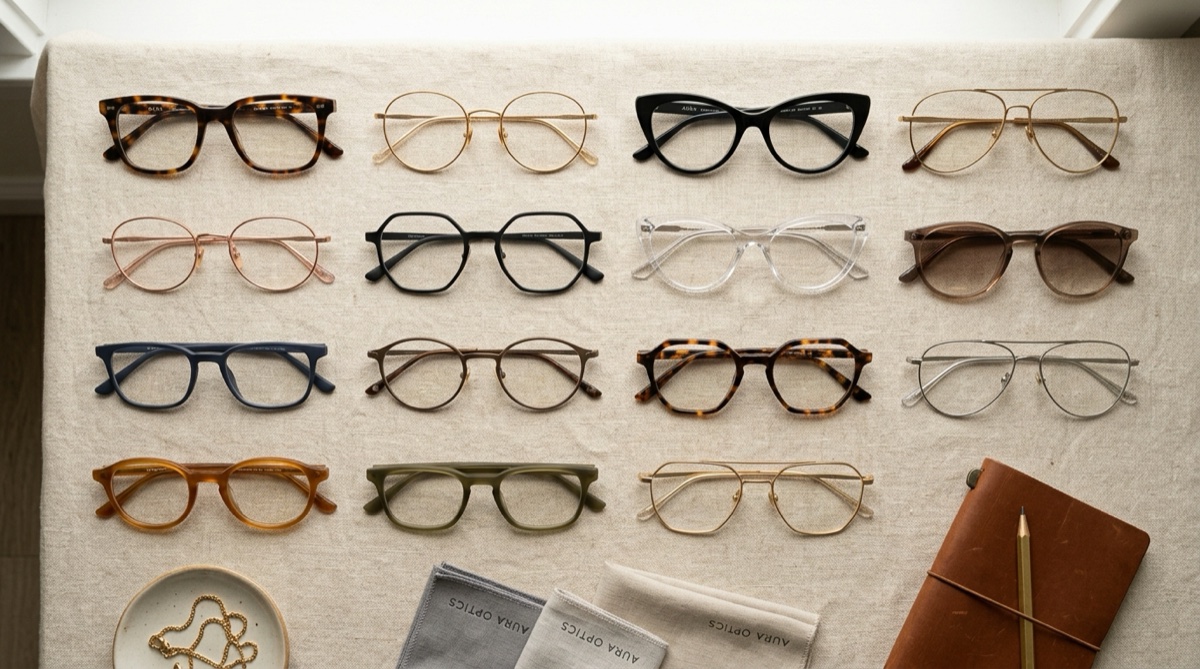 Different eyeglass frame shapes to suit different face shapes
| Tool | Type | What it's best at | Tool cost |
|---|---|---|---|
| Warby Parker | Try-on + finder | Realistic TrueDepth try-on + AI Advisor | Free (glasses from $95) |
| Zenni Optical | Try-on | Cheap frames + real PD/scale measurement | Free (glasses from $6.95) |
| GlassesUSA | Try-on + finder | Huge multi-brand range + "Pairfect Match AI" | Free (glasses ~$29+) |
| EyeBuyDirect | Try-on | Rock-bottom prices + flexible try-on | Free (glasses from $6) |
| Roka | Try-on | Sport/performance frames + home tryout | Free (glasses ~$175+) |
| MaxAura | Frame finder | Which shapes suit you + hair + color | Free trial, no card |
| YouCam | Finder + try-on | Free, retailer-neutral shape + try-on | Free (app) |
| Yesglasses / VisuTry | Frame finder | Free shape verdict; VisuTry runs on-device | Free |
The Try-On Mirrors (See Frames Before You Buy)
Warby Parker has the most realistic try-on here — it uses the iPhone's TrueDepth sensor for genuine 3D fit — plus Advisor, an AI that scans your face and recommends frames, so it does both jobs. Glasses start at $95 including prescription lenses. One important, time-sensitive note: Warby Parker is discontinuing its famous free 5-pairs Home Try-On (announced in 2025, winding down by year-end), pushing everyone to virtual try-on and stores — so the mail-me-frames option many readers remember is going away.
Zenni Optical pairs a 3D scan with a real credit-card scale step, so it actually measures your PD and face width — useful for fit — over an enormous catalog of frames from $6.95. Its face-shape help is browse-by-filter, not an AI verdict.
GlassesUSA spans budget house frames to designer names (Ray-Ban, Gucci), and its Pairfect Match AI reads your facial structure to recommend frames you then try on. Heavy promos make the true entry price hard to pin, but prescription pairs commonly start around $29.
EyeBuyDirect offers live or recorded-video try-on over ultra-cheap frames from $6, with a clear written guide to self-identify your shape. Roka is the pick for sport and performance frames (and, unlike Warby Parker, still mails you a home tryout), though frames run $175+. Glasses.com (owned by EssilorLuxottica) is the place to try designer brands via its Virtual Mirror.
Non-US readers: Lenskart — huge across India, the Middle East, and Asia — has one of the strongest true AI face-analysis try-ons anywhere, reading your face shape and temple width in seconds. It's just not a mainstream US retailer.
The Frame Finders (Which Shapes Suit You)
MaxAura is a pure frame finder: from one selfie it detects your face shape and recommends the eyewear shapes that suit you — alongside your hairstyle and color season. It doesn't do AR try-on and doesn't sell frames, which is the point — it's retailer-neutral advice. The honest limits: it processes your photo in the cloud (the on-device options below are more private), and it names shapes to look for rather than showing frames on your face. Use it to decide what to look for, then try those shapes on at any mirror above. Free trial, no card.
YouCam (by Perfect Corp) is the strongest free all-rounder — it detects your face shape and does AR try-on, brand-agnostically, and it's the engine quietly powering many retailers' try-ons. Yesglasses and GlassesShop offer free AI shape detection tied to their catalogs, and VisuTry stands out for running its detector on-device with retailer-neutral "wear / avoid / try" advice. A cluster of independent free detectors (FaceShapeDetector.app, SitNit, Somake) do the same quick shape read.
Under the hood: most retailer mirrors aren't built in-house. Two engines power a huge share of them — FittingBox (which acquired the pioneering Ditto in 2023 and holds the largest digital-frame database) and Perfect Corp / YouCam. When two different stores' try-ons feel identical, this is why.
Smart Glasses (Ray-Ban Meta): It's About Fit, Not Shape
If you searched "smart glasses face shape," you're probably eyeing Ray-Ban Meta — and here the usual advice flips. Smart glasses come in only a couple of shapes, so the real question isn't which shape suits you but which size fits you.
Ray-Ban's guidance is measurement-based: pick a frame width 2–3 mm under your face width, choose Standard vs Large, and match your bridge fit (a quick selfie test — draw a line across your pupils; if your nose bridge sits above the line you're "high bridge," below it "low bridge"). A frame finder can still tell you whether that one Wayfarer shape flatters you, but the sizing is what makes or breaks the buy.
How to Actually Use These Tools
- Start with a frame finder (MaxAura, YouCam) to learn which shapes suit your face.
- Then open a try-on mirror (Warby Parker, Zenni) and preview those shapes on your face.
- Check the fit numbers — frame width against your face width, bridge, temple length — not just the look.
- See an optician for the final call, especially for prescription lens centring. Virtual PD is a starting point, not a substitute.
Frequently Asked Questions
Q: Are virtual try-on glasses accurate?
For looks, yes — they're reliable for judging style, proportion, and rough size. For fit, be cautious: they estimate your measurements and can't convey weight, comfort, or true color. Treat try-on as a styling preview, and confirm bridge and temple fit in the real world before relying on it.
Q: Which glasses suit my face shape?
Choose frames that contrast your face's shape: angular frames for round faces, round or oval for square, bottom-heavy or aviator for heart, cat-eye or browline for diamond. Oval faces suit almost anything. Match the frame width to the widest part of your face — and remember these are guidelines, not rules.
Q: What's the difference between a try-on app and an AI frame finder?
A try-on app shows what specific frames look like on you — you still choose which. A frame finder tells you which shapes suit your face in the first place. Try-on answers "does this pair look good?"; a finder answers "what should I even be looking for?" Use a finder first, then a try-on.
Q: Are AI glasses apps safe to use with my photo?
It depends on the tool. Some (like on-device face-shape detectors) never upload your photo — it's processed locally. Others send it to a server; reputable ones delete it after and don't sell it, but check the privacy policy. If facial-data privacy matters to you, favour an on-device tool.
Q: Can I measure my pupillary distance (PD) at home?
Roughly, yes — many tools use a credit card held against your face as a scale reference to estimate PD. It's good enough for choosing frame size, but it's not precise enough for centring prescription lenses. For that, get your PD measured by an optician.
Q: Do virtual try-ons work for smart glasses like Ray-Ban Meta?
Somewhat, but smart glasses are a sizing decision, not a shape one — they come in few shapes. Use Ray-Ban's size and bridge-fit guide (frame width just under your face width, standard vs large, high vs low bridge) rather than a shape recommender.
The Bottom Line
The "best AI glasses tool" depends on which question you're asking. To learn which frames suit you, start with a frame finder; to see a specific pair on your face, use a try-on mirror; to actually wear them comfortably, mind the fit numbers and see an optician. No single tool does all three honestly — and the ones that try are usually selling you their own frames.
 Woman wearing eyeglasses that suit her face shape
If you'd rather start with the honest first step — which frame shapes suit your face, plus the hairstyle and colors that go with them, from one selfie, free and with no card — find your frames with MaxAura and get your recommendations in about 60 seconds.