How AI Is Revolutionizing Eyewear Selection by Face Shape
Choosing glasses used to mean trying on dozens of frames and trusting a mirror. AI now reads your face shape from a selfie and tells you which frames fit — and which to skip. Here's how it works.
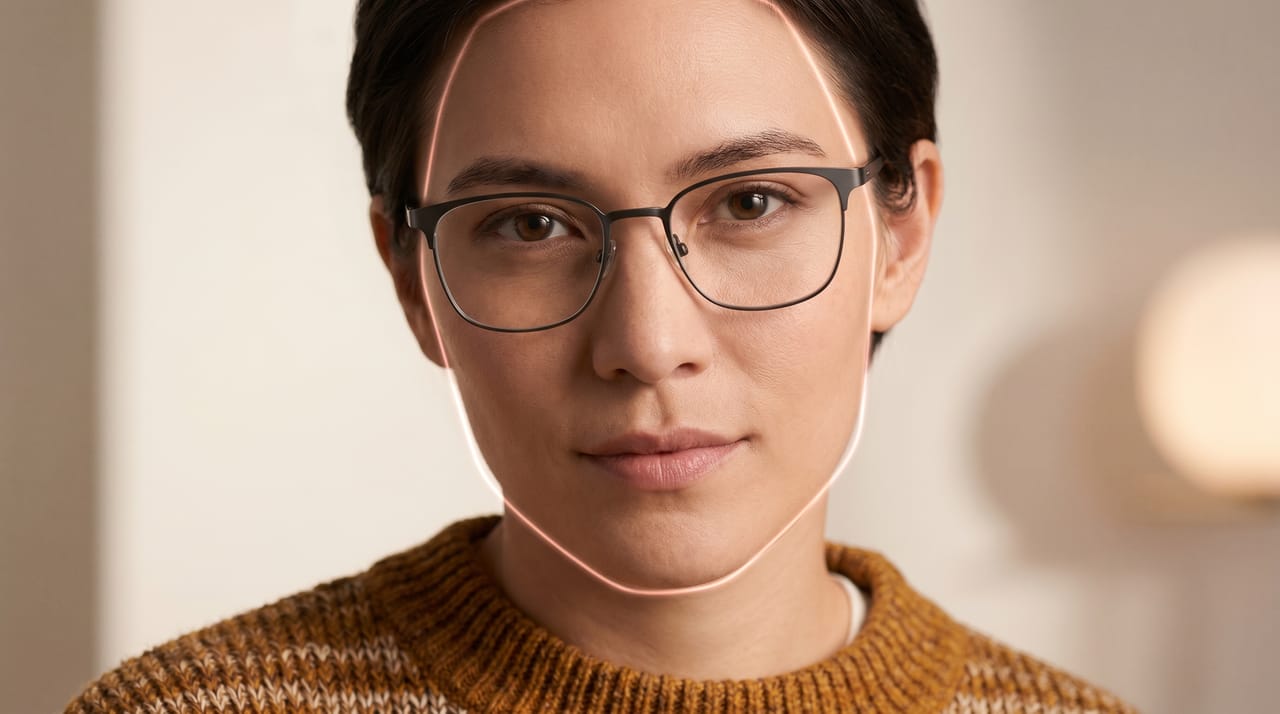
You're in the optical shop holding your fourteenth pair of frames, and they all look basically fine, which is its own kind of problem. The mirror isn't helping. The sales associate likes the expensive ones. You leave with a pair you're 60% sure about and $300 lighter.
Picking glasses has always been a guessing game played against a mirror — and the mirror is a poor judge of your own face.
AI rewrote the process. Instead of trying everything and hoping, you upload a selfie, the system reads your facial geometry, and it tells you which frame shapes balance your face and which fight it. Here's how the technology works, and how to use it to choose frames with actual confidence.
Why Face Shape Decides Which Glasses Suit You
Eyewear is the most prominent accessory on your face, sitting dead center. The right frame balances your proportions. The wrong one amplifies whatever you'd rather downplay.
The guiding principle is contrast: frames that contrast your face shape create balance.
- Round faces suit angular, geometric frames — rectangles, squares, bold cat-eyes — that add definition.
- Square faces suit rounder, softer frames — round, oval, aviators — that ease a strong jaw.
- Heart faces suit frames that are wider at the bottom, balancing a broader forehead.
- Oval faces have balanced proportions and can wear most shapes, so the choice shifts to size and color.
Knowing your shape turns a wall of identical-looking frames into a short, confident shortlist. If you're unsure of yours, the free face shape detector reads it from a selfie, or our face shape guide shows how to measure it.
How AI Reads Your Face for Frame Recommendations
AI doesn't judge frames by taste. It measures your face, then applies the contrast principle as math.
When you upload a photo, the system detects facial landmark points and calculates the ratios that define your shape: forehead width, cheekbone width, jaw width, and face length. From those it classifies your face shape, then maps the frame geometries that balance it.
Because it measures rather than eyeballs, AI face-shape detection is far steadier than the mirror, where angle and distance distort what you see. The result isn't "these look nice." It's "these proportions suit your proportions, and these don't."
Good systems go a step further and factor in coloring: warm skin tones pair with gold, tortoiseshell, and warm frames; cool tones with silver, black, and jewel tones. The same logic behind your seasonal color palette applies to the metal and tone of your frames.
Virtual Try-On vs AI Recommendation — They're Not the Same
People conflate two different technologies. Knowing the difference helps you use each well.
Virtual try-on uses augmented reality to render frames onto your live face so you can see the look. It answers "how does this pair look on me?" Retailers love it because it works — FittingBox reports a 22% drop in cart abandonment for stores that offer it, and Deloitte found AR try-on cuts product returns by around 28%.
AI recommendation analyzes your face shape and tells you which frames to try in the first place. It answers "what should I be looking at?"
The best workflow uses both in order: let AI narrow the field to frames that suit your face, then use virtual try-on to choose among the finalists. Try-on alone still leaves you scrolling hundreds of options; recommendation first makes it efficient.
How to Use AI to Find Your Frames: Step by Step
Step 1: Take a clear, front-facing selfie
Face the camera straight on, chin level, in soft even light. Push hair off your face so your full outline is visible — the analysis depends on a clean read of your jaw, cheeks, and forehead.
Step 2: Get your face shape and frame guidance
Upload and let the AI classify your shape and return the frame geometries that balance it — ideally with shapes to seek and shapes to avoid, plus color direction for the frame tone.
Step 3: Shortlist with virtual try-on
Take the recommended shapes to a retailer's virtual try-on (Warby Parker, Lenskart, and many others offer it) and preview the finalists on your face. Some iOS try-on tools even measure your pupillary distance using the depth camera.
Step 4: Confirm fit in real life
AI nails the shape question. It can't feel how frames sit on your nose or behind your ears. For your final pair, confirm comfort and prescription fit physically or via a retailer's return policy.
What AI Can't Tell You About Glasses
AI is excellent at the structural call — which shapes flatter your face — which is exactly the part people get wrong alone. But a few things still need the real world.
Comfort, weight, how frames sit on your specific nose bridge, prescription thickness in a given frame, and how a material feels after eight hours of wear — these are physical, not visual. Use AI to choose the shape and color with confidence, then let a real try-on settle fit.
Q: Can AI tell me which glasses suit my face?
Yes. AI reads your face shape from a selfie by measuring facial landmarks, then recommends frame shapes that balance your proportions using the contrast principle — angular frames for round faces, softer frames for square faces, and so on. It's more consistent than judging your shape in a mirror, though a face between two shapes can reasonably read as either.
Q: What glasses are best for my face shape?
As a rule, choose frames that contrast your face shape: round faces suit angular frames, square faces suit round or oval frames, heart faces suit frames wider at the bottom, and oval faces can wear most shapes. AI analysis confirms your exact shape and tailors the recommendation rather than relying on the general rule.
Q: Is AI glasses recommendation the same as virtual try-on?
No. AI recommendation analyzes your face shape to tell you which frames to consider. Virtual try-on uses AR to show how a specific pair looks on your face. They work best together — recommendation narrows the options, then try-on helps you choose among the finalists.
Q: How accurate is AI for choosing eyewear?
Good for the shape question, as long as the photo is straight-on and well lit. Faces often sit between two shapes, so treat the result as a starting point. It can't judge physical comfort, nose-bridge fit, or prescription lens thickness, so confirm those in person or through a retailer's return policy before buying.
Find Your Frames Without the Guesswork
The wall of frames at the optician all look fine because a mirror can't tell you which ones balance your face. Your facial geometry can — you just need it read accurately.
MaxAura analyzes your face shape from one selfie and returns specific eyewear guidance — frame shapes to seek, shapes to avoid, and sizing — alongside your color season and best hairstyles, so the whole look fits together.
Stop guessing at the optician. Try MaxAura's free analysis and get your eyewear recommendations in seconds.