How to Test Your Skin Undertone: 5 Methods That Actually Work
Warm, cool, neutral, or olive? Five undertone tests ranked from least to most reliable — the vein check, jewelry test, white-cloth test, a free quiz, and an AI photo read.
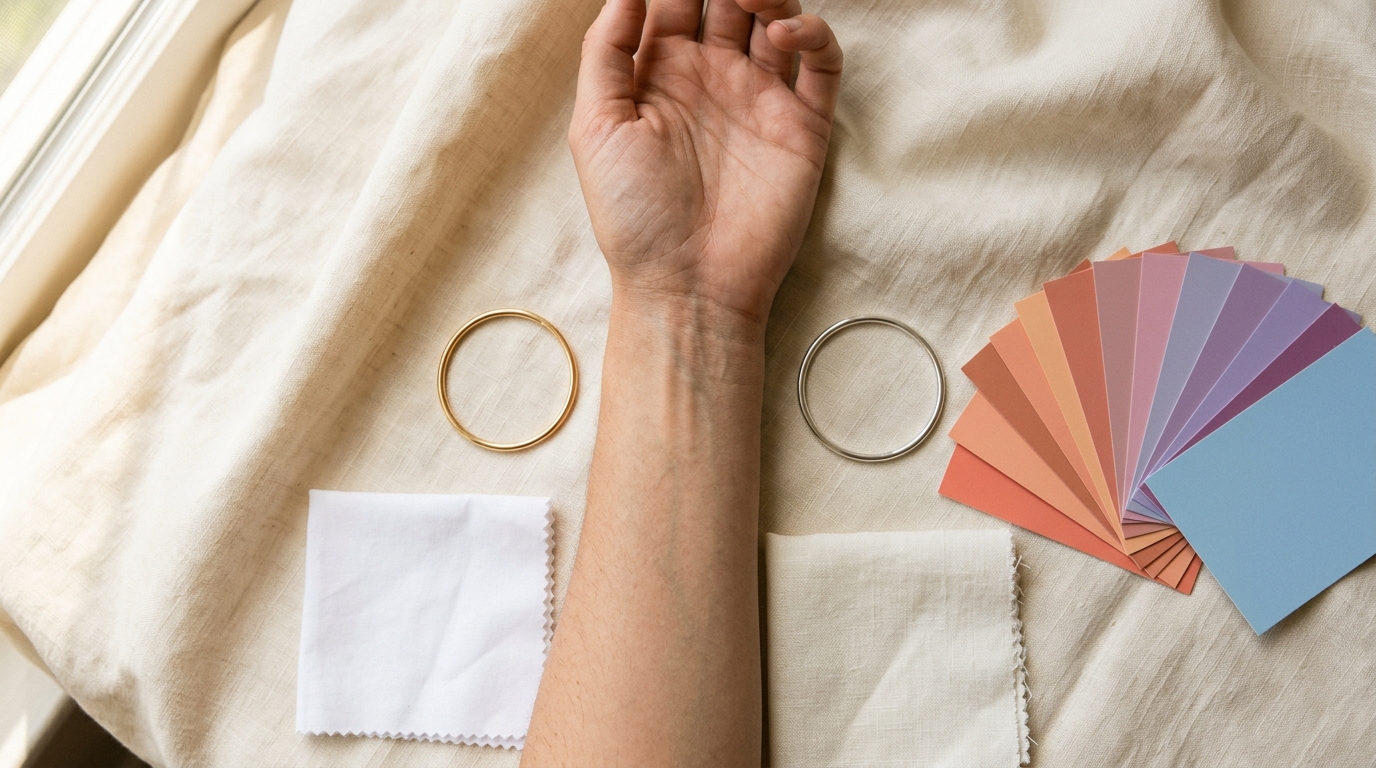
Your skin undertone is the subtle cast beneath the surface of your skin — golden (warm), rosy (cool), balanced (neutral), or muted green (olive). Unlike your skin's surface tone, it never changes with a tan, and it decides which clothing colors, hair shades, makeup, and jewelry metals make you look vibrant instead of washed out. Here are five ways to test it, ranked from least to most reliable.
First: Undertone vs. Skin Tone — They're Not the Same Thing
Skin tone is how light or deep your skin is — fair, medium, tan, deep. Undertone is the hue underneath it. Two people with the same skin depth can have opposite undertones, and every undertone appears at every depth: there are deep cool complexions and fair warm ones. This is why foundation matched only to depth so often looks slightly gray or orange — the undertone was wrong, not the shade.
The four undertone families:
- Warm — a golden, peachy, or yellow cast. Earth tones, ivory, and gold jewelry sit naturally.
- Cool — a pink, red, or bluish cast. Jewel tones, true white, and silver sit naturally.
- Neutral — a balance of warm and cool. Most colors work in their softer, mid-range versions.
- Olive — a subtle green-gray cast, often mistaken for warm. Muted, earthy, and desaturated colors work; very bright warm shades can clash.
Method 1: The Vein Test (Quick but Crude)
Look at the veins on your inner wrist in natural daylight.
- Greenish veins suggest a warm undertone — yellow skin over blue veins reads green.
- Blue or purple veins suggest a cool undertone.
- Can't decide, or you see both? That points to neutral — or to the test simply failing you, which is common.
The vein test is popular because it takes ten seconds, but it's the least reliable method here: vein color varies with skin depth, temperature, and lighting, and olive undertones almost always read ambiguous. Treat it as a first hint, not an answer.
Method 2: The Jewelry Test
Hold gold jewelry against one side of your bare face or wrist and silver against the other, in daylight, and ask which makes your skin look healthier and brighter — not which you prefer.
- Gold flatters → warm undertone.
- Silver flatters → cool undertone.
- Genuinely both → neutral.
This works because metals reflect their color onto your skin: gold amplifies a golden cast, silver amplifies a rosy one. Its weakness is bias — most of us have worn one metal for years and our eye defaults to it.
Method 3: The White-Cloth Test
Hold a piece of pure white fabric under your chin in daylight, then swap it for off-white or cream.
- If true white makes your face look fresh while cream dulls it → cool undertone.
- If cream flatters while stark white makes you look tired or sallow → warm undertone.
- If both look fine → neutral.
This is the same principle professional color analysts use with draping — comparing how your skin responds to warm versus cool fabric next to your face. Done carefully, it's more trustworthy than veins or jewelry, but you still need daylight, a bare face, and honest eyes.
Method 4: A Structured Quiz (Free, No Photo Needed)
A good undertone quiz stacks several of these observations — vein color, jewelry, how you tan, which colors people compliment you in — and scores them together, which cancels out the noise of any single test. Our free undertone quiz does exactly that in seven questions and gives you your undertone plus the colors and metals that suit it, no sign-up required.
A quiz's ceiling is your own self-observation: it's asking you to judge your veins and your tan. If you've ever answered "I honestly can't tell" three questions in a row, you've found the limit.
Method 5: An AI Photo Analysis (The Most Direct Read)
Undertone is a visible property of your skin — which means it can be measured from a photo instead of self-reported. MaxAura's AI analysis maps your face from one selfie and reads the cast of your skin alongside your natural hair depth and eye clarity — the same markers a professional analyst checks in person. Your report labels your undertone explicitly — Warm, Cool, Neutral, or Olive — with the visible cue that decided it, and builds your full seasonal color palette on top.
Two honest caveats. First, photo quality matters: warm indoor bulbs and beauty filters shift how your undertone reads, so use natural daylight and an unfiltered, front-facing photo. Second, no method — human or AI — is infallible on a bad input; the difference is that MaxAura checks your photo first and tells you when something limits the read. You can see exactly what the analysis measures on our method page.
Which Test Should You Trust?
| Method | Effort | Reliability | Catches olive? |
|---|---|---|---|
| Vein test | 10 seconds | Low | Rarely |
| Jewelry test | 1 minute | Low–medium | Rarely |
| White-cloth test | 5 minutes | Medium | Sometimes |
| Structured quiz | 1–2 minutes | Medium–high | Sometimes |
| AI photo analysis | 60 seconds | High (with a good photo) | Yes — labeled explicitly |
If two manual tests agree, you very likely have your answer. If they disagree — or everything reads "sort of both" — you're probably neutral or olive, and that's exactly where a measured read earns its keep.
What to Do With Your Undertone Once You Know It
- Warm: camel, rust, olive, cream, warm reds; gold metals; golden or caramel hair tones.
- Cool: navy, emerald, berry, true white, blue-based reds; silver and platinum; ash or cool-brown hair tones.
- Neutral: soft, mid-saturation versions of nearly everything; mixed metals are fine.
- Olive: muted and earthy shades — sage, taupe, dusty rose; avoid neon brights and very yellow golds.
Your undertone is the foundation; your full color season adds how deep, clear, and contrasting your best colors should be. That's the difference between knowing you're warm and knowing you're a True Autumn.
Want it measured instead of guessed? Upload one photo and MaxAura labels your undertone and your complete color season in about 60 seconds — first analysis free, no card required.